ConvolvedDistributions
Raw-distribution convolution and shared numeric quadrature for any Distributions.jl distribution.
Why ConvolvedDistributions?
A convolution is usually only available in closed form for a few matching distribution families;
convolvedbuilds the distribution of a sum of independent delays from any two or moreDistributions.jldistributions, not just those pairs.Closed-form convolutions (
Normal+Normal, equal-scaleGamma, equal-rateExponential) are used where they exist, with an AD-safe Gauss-Legendre quadrature fallback for every other pair.Sums are not the only combination we support:
differencebuilds theX - Ysigned gap between two independent events,producttheX * YMellin convolution for a delay scaled by an independent multiplicative factor, andratiotheX / Yquotient for a rate, a proportion, or a normalised measurement.Turning expected events into expected downstream counts is usually a hand-rolled discrete convolution;
convolve_seriesdoes it directly from a numeric series and a delay's PMF, including a delay that changes over the series (one distribution or PMF per time point).
Getting started
See the Getting started documentation for a full walkthrough.
The following example convolves two delays, an incubation period and a reporting delay, and evaluates the resulting distribution:
using ConvolvedDistributions, Distributions

incubation = Gamma(2.0, 1.0)
reporting = LogNormal(1.0, 0.5)
d = convolved(incubation, reporting)

(cdf(d, 5.0), pdf(d, 5.0))
(0.5555707883725697, 0.18877150759921843)difference gives the gap between two independent events:
z = difference(Normal(5.0, 1.0), Normal(2.0, 1.0))

(mean(z), cdf(z, 0.0))
(3.0, 0.016947426762344637)A Convolved distribution is a UnivariateDistribution, so it composes with Distributions.truncated.
d_trunc = truncated(d; upper = 10.0)

cdf(d_trunc, 5.0)0.5725523804006694Loading the Optimization extension adds quantile support by numerically inverting the CDF:
using Optimization, OptimizationOptimJL

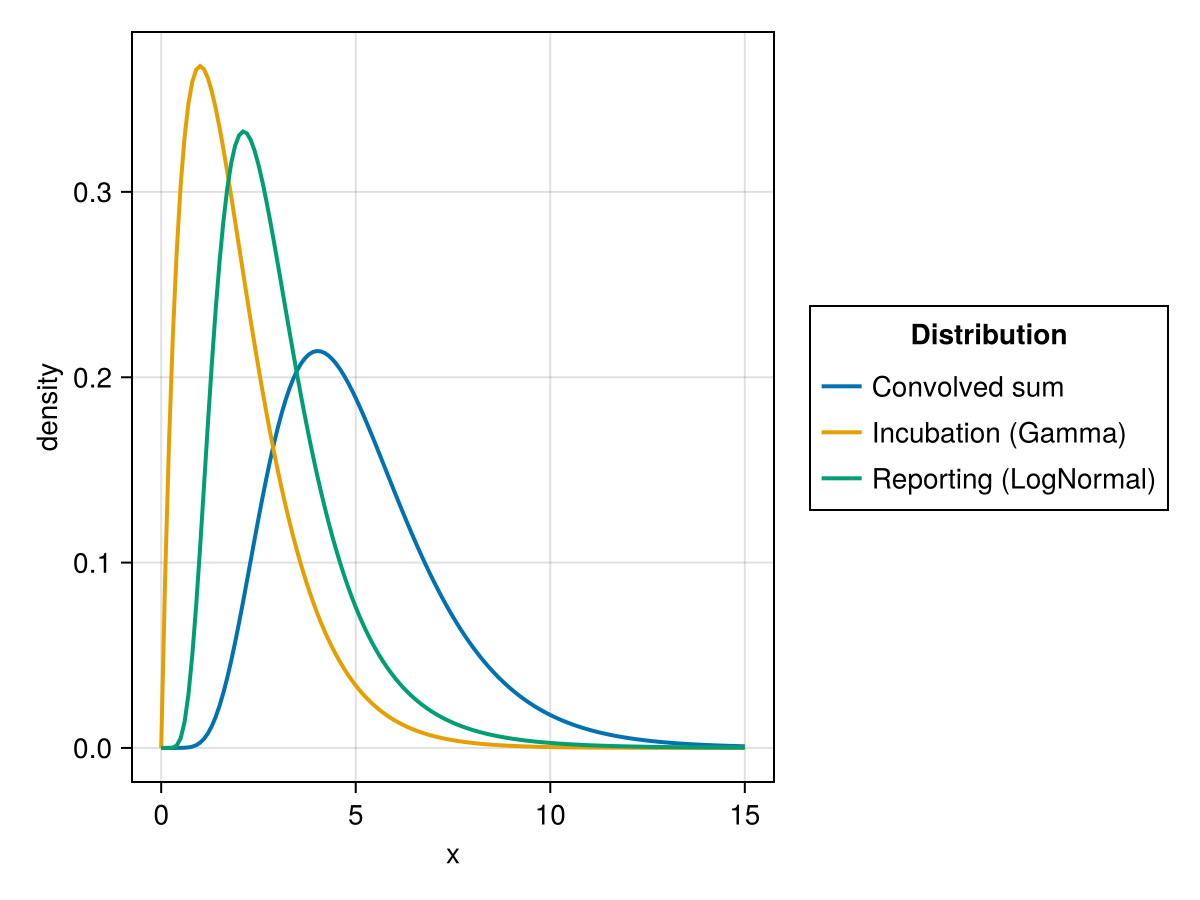
quantile(d, 0.5)4.714710420969208The components and their sum can be compared visually,
using CairoMakie, AlgebraOfGraphics, DataFramesMeta

CairoMakie.activate!(type = "png", px_per_unit = 2)

x = 0.0:0.1:15.0
df = vcat(
    DataFrame(x = x, density = pdf.(incubation, x),
        Distribution = "Incubation (Gamma)"),
    DataFrame(x = x, density = pdf.(reporting, x),
        Distribution = "Reporting (LogNormal)"),
    DataFrame(x = x, density = pdf(d, collect(x)),
        Distribution = "Convolved sum")
)
draw(
    data(df) *
    mapping(:x, :density, color = :Distribution) *
    visual(Lines, linewidth = 2)
)
Relationship to Distributions.jl
Distributions.jl ships a convolve function, but it only covers pairs with a closed-form result:
| Aspect | Distributions.jl convolve | ConvolvedDistributions.jl convolved |
|---|---|---|
| Coverage | Closed-form, same-family pairs only (e.g. Normal + Normal, equal-scale Gamma); errors otherwise | Any pair of univariate distributions |
| Method | Returns the closed-form distribution | Analytic fast path where a closed form exists, AD-safe Gauss-Legendre quadrature fallback otherwise |
| Forms | Two positional arguments | Nested, vector, tuple, and varargs forms for sums of many delays |
| Differences | Not supported | difference builds the X - Y dual |
| Products | Not supported | product builds the X * Y Mellin convolution |
| Ratios | Not supported | ratio builds the X / Y Mellin-quotient form |
For example, Distributions.convolve(Gamma(2, 1), LogNormal(0, 1)) throws a MethodError and Distributions.convolve(Gamma(2, 1), Gamma(3, 2)) throws an ArgumentError because the scales differ, whereas convolved handles both via quadrature. When a closed form does exist, convolved uses it.
Related packages
ComposedDistributions.jl re-exports this package directly, so a composed chain collapses to its convolved total via
observed_distribution.ModifiedDistributions.jl applies its forward-series transforms (
thin,cumulative) to a convolved series, and lets modified distributions serve as convolution components.LoweredDistributions.jl lowers a
convolvedsum to one combined dynamical-systems representation, folding the components' phase-types in series rather than lowering each separately.CensoredDistributions.jl adds censoring and truncation layers for epidemiological observation processes; this package was split out of it, and
convolve_seriesreads its double-interval-censored masses directly.DistributionsInference.jl is the emerging fit-protocol and PPL-integration layer across the EpiAware distribution packages.
Where to learn more
Want to get started running code? Check out the Getting started documentation.
Want to understand the API? Check out our API reference.
Want to contribute to
ConvolvedDistributions? Check the open issues and the Contributing section below.Want to see our code? Check out our GitHub Repository.
Getting help
For usage questions, ask on the Julia Discourse or the epinowcast community forum, our home for epidemiological modelling questions. Please use GitHub issues for bug reports and feature requests only.
Contributing
We welcome contributions and new contributors! This package follows ColPrac and is formatted with Runic.
Supporting and citing
If you would like to support ConvolvedDistributions, please star the repository — such metrics help secure future funding.
If you use ConvolvedDistributions in your work, please cite it:
@software{ConvolvedDistributions_jl,
  author       = {Sam Abbott and EpiAware contributors},
  title        = {ConvolvedDistributions.jl},
  year         = {2026},
  url          = {https://github.com/EpiAware/ConvolvedDistributions.jl}
}
A citable DOI will be added with the first tagged release.
Code of conduct
Please note that the ConvolvedDistributions project is released with a Contributor Code of Conduct. By contributing, you agree to abide by its terms.